
introduction to Uruguay’s natural history — from Ice Age giants
and fossils to the country’s present-day wildlife.
It is especially interesting for families and newcomers,
as the museum is easy to include in an afternoon itinerary and admission is free.
scientific institutions. The public exhibition is small and compact, but it offers a
impressive overview of the country’s natural history — from dinosaurs and
Ice Age megafauna to species that still live in Uruguay today.
According to the museum’s current official information, admission is free.
Anyone living in Uruguay or visiting Montevideo with an interest in fossils, natural history, and South American wildlife will find the Museo Nacional de Historia Natural a surprisingly compact yet very worthwhile place to explore the country’s past and present.
The museum’s history dates back to the first decades following Uruguay’s independence. In 1837, a commission was established to create a national museum, and the institution opened its doors for the first time in 1838. Today, the museum is part of the Ministerio de Educación y Cultura and combines public exhibitions, scientific research, and extensive collections.
The public exhibition is located at Miguelete 1825 in the Aguada neighborhood. The scientific collections and specialist library are housed separately. This means that what visitors see in the museum is only a small part of a much larger natural history collectio
From dinosaurs to Ice Age giantsThe exhibition takes visitors through major chapters of Uruguay’s natural history. Particularly impressive are the fossils and reconstructions of animals that shaped South America long before today’s fauna appeared.
Among them are glyptodonts — heavily armored relatives of modern armadillos that could reach sizes closer to a small car than to any armadillo alive today. Some of their armor plates can even be touched. For children in particular, this is a great way to experience paleontology beyond simply looking at fossils behind glass.
Doedicurus is another of the exhibition’s most striking animals. This massive armored herbivore had a characteristic club-like tail, and it is one of those creatures whose true scale is far more impressive in person than in photographs or books.
Mehr
Einfluss
Wir machen den Unterschied, jeden Tag!
Wichtiger
Meilenstein
Erreichen Sie neue Höhepunkte mit uns
Innovationszentrum
Wo Ideen zum Leben erweckt werden
Fokus der
Community
Verbindungen schaffen
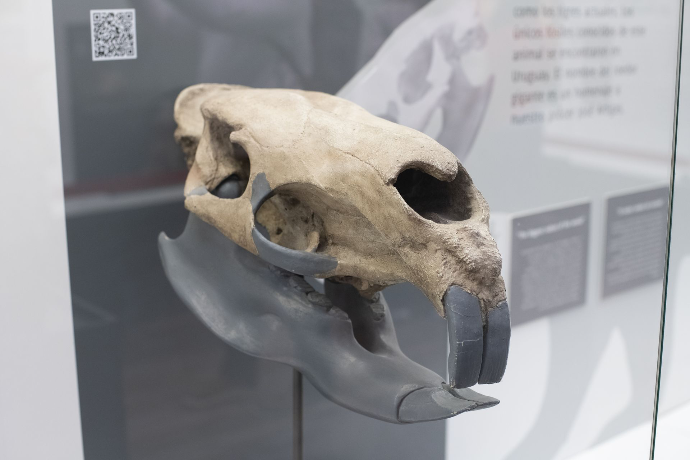
One of the museum’s most scientifically significant fossils is Josephoartigasia monesi. This extinct animal lived in what is now Uruguay and is considered the largest known rodent in Earth’s history.
With its enormous body size, Josephoartigasia looked more like a large hoofed mammal than a mouse or guinea pig. The fossil provides a vivid example of how unusual South America’s wildlife became over millions of years of evolution.
Smilodon, Megalodon, and other prehistoric animals
Another eye-catching exhibit is a Smilodon skull. Its greatly elongated canine teeth are among the most recognizable features of South America’s Ice Age predators. According to the museum label, the skull on display is a replica.
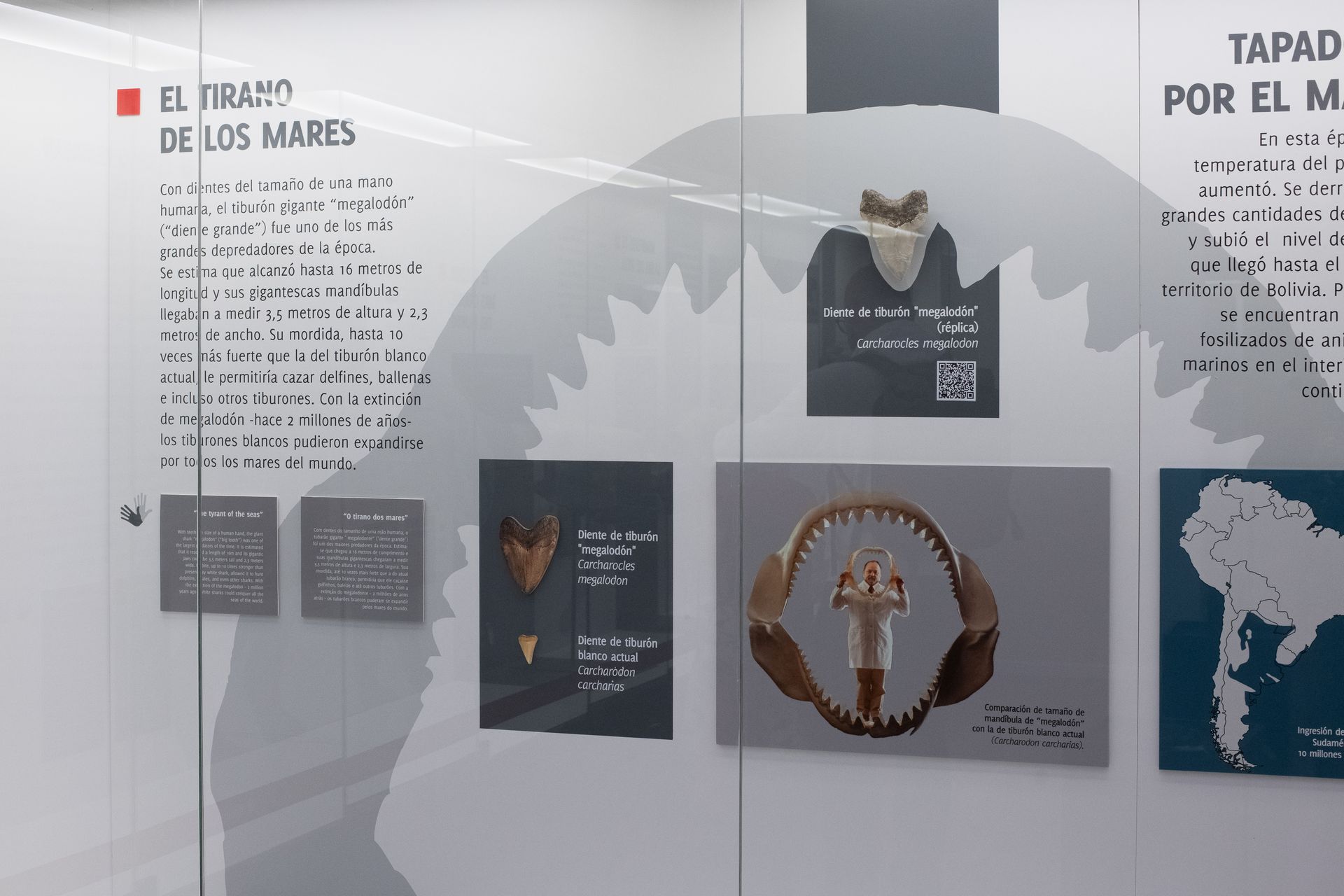
The oceans are represented as well. One section focuses on Megalodon and compares its massive teeth with those of modern sharks. These direct size comparisons work particularly well because the scale of the animal becomes immediately understandable without lengthy explanations
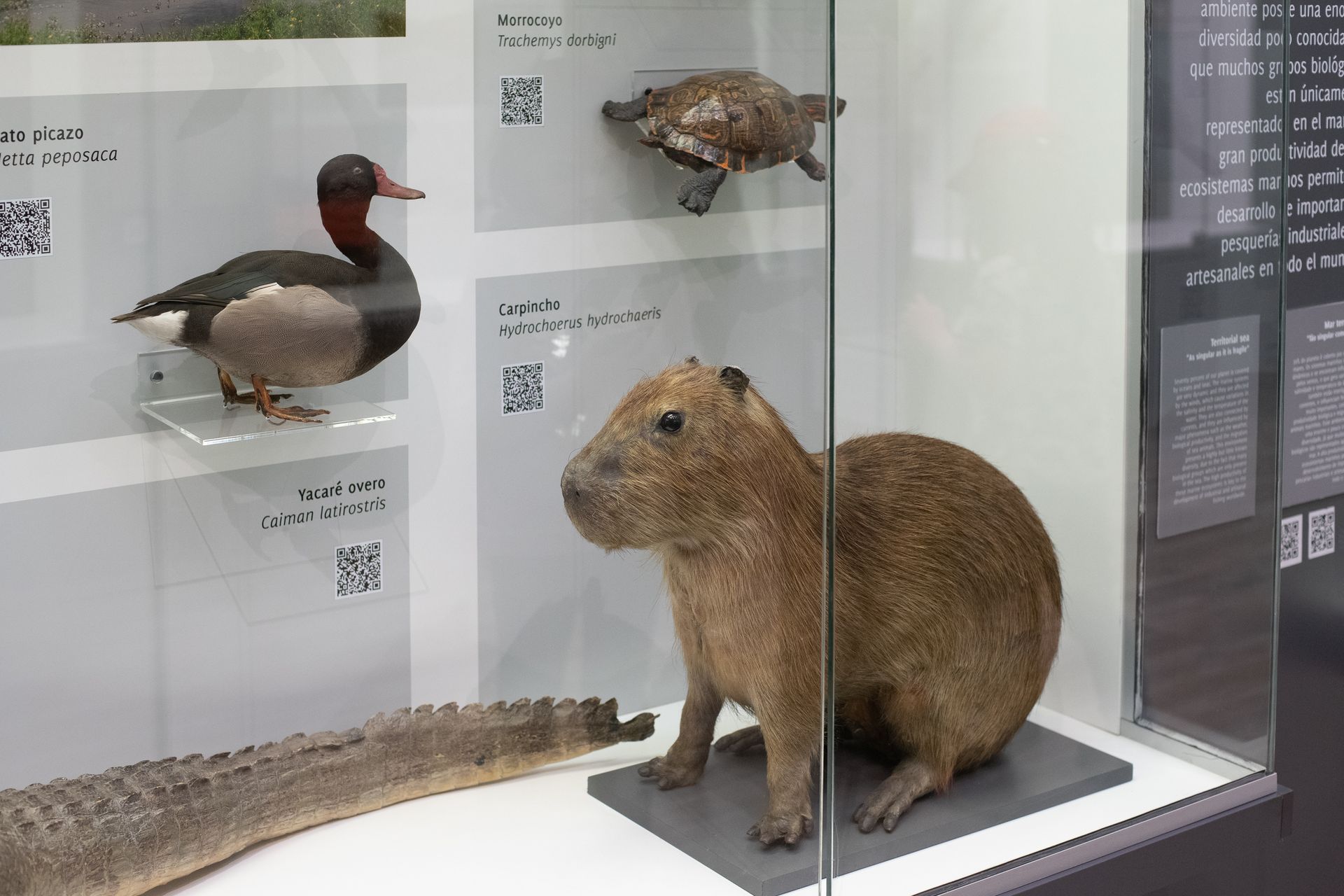
Alongside prehistoric animals, the museum also presents species that still live in Uruguay today. Small dioramas and preserved specimens show typical inhabitants of wetlands, coastal areas, and other environments, including waterbirds, turtles, armadillos, caimans, and the carpincho, or capybara.
For families who are new to Uruguay, this part is especially interesting. Many of the animals first encountered in the museum may later be seen in real life around lagoons, in rural areas, or along the Atlantic coast.
Penguins as winter visitors to Uruguay’s coast
The Magellanic penguin is also represented in the exhibition. These birds do not breed in Uruguay, but they do reach the Uruguayan coast seasonally. The museum’s digital species information explains that they breed in large colonies in Argentina and pass through Uruguay during their migrations.
QR codes placed near the displays lead to digital species profiles and additional information. The Magellanic penguin profile we accessed, for example, includes information about behavior, diet, distribution, and its presence in Uruguay.
The museum states that exhibition texts are available in Spanish, English, and Portuguese. Its official visitor information also mentions QR codes offering interpretation in Lengua de Señas Uruguaya (LSU), Uruguay’s sign language.
It is important to make a distinction: not every QR code next to an exhibit leads to sign-language content.
Many QR codes link to standard digital species profiles. The LSU resources are listed by the museum as an additional accessibility feature.
The museum also provides an elevator and accessible restrooms.
Visitors familiar with major international natural history museums should not expect enormous exhibition halls. The main exhibition is compact and can comfortably be visited in about 45 minutes to one hour.
This is especially convenient for families with children. The visit is long enough to discover something new, but short enough not to become exhausting. The combination of fossils, reconstructions, modern wildlife, and digital information still provides plenty of variety.
Historic architecture and contemporary art
The building itself also contributes to the atmosphere. Historic architectural elements, old walls, and visible signs of age create an interesting contrast with the modern display cases.
The same building complex is also home to the Espacio de Arte Contemporáneo. Depending on the current program, a visit to the natural history museum can therefore be combined with contemporary art. During our visit, the exhibition Serpentario by Juan Burgos was on display.
Good to know before visiting
Address: Miguelete 1825, Montevideo (Aguada)
Opening hours:
Wednesday to Saturday, 1:00–7:00 p.m.
Sunday, 11:00 a.m.–5:00 p.m.
Admission: Free according to the museum’s current official visitor information
Recommended visit duration: Approximately 45–60 minutes
Accessibility: Elevator, accessible restrooms, multilingual exhibition texts; according to the museum, additional LSU content is available via QR code
Phone: +598 2929 0517
Email: visita.mnhn@mec.gub.uy
Conclusion
The Museo Nacional de Historia Natural is not the kind of museum that requires an entire day — and that is exactly part of its appeal. It works very well as a short stop in Montevideo and manages to present a surprising amount of Uruguay’s natural history within a relatively small space.
For families and newcomers, the museum is particularly interesting because it connects prehistoric giants with the wildlife that can still be encountered throughout the country today. Between glyptodonts, Doedicurus, Josephoartigasia, capybaras, and penguins, it quickly becomes clear just how diverse Uruguay’s natural history really is.
Sources and date: Museo Nacional de Historia Natural / Ministerio de Educación y Cultura Uruguay, as well as the museum’s digital species information. Opening hours, admission, and visitor information current as of September 2026.
Before visiting, it is advisable to check the museum’s current website.