
Uruguay reports a significant decline in poverty and extreme poverty for the first half of 2026. The share of people below the national poverty line fell within a year from 17.7 to 14.8 percent. An international comparison is interesting but must be read with caution: Uruguay, Germany, the EU, and the USA measure poverty using different methods.
In short: In Uruguay, 14.8 percent of the population lived below the national poverty line in the first half of 2026. A year earlier, it was still 17.7 percent. Extreme poverty also decreased. What matters less is a ranking with other countries, but the noticeable improvement within Uruguay.
Significant decline in Uruguay
According to the Uruguayan National Institute of Statistics (INE), the poverty rate fell to 14.8 percent in the first half of 2026. In the same period in 2025, it was still 17.7 percent. This corresponds to a decrease of 2.9 percentage points.
Extreme poverty, which is recorded in Uruguay as indigencia, also decreased: The share of affected people fell from 1.8 to 1.2 percent. Among households, the poverty rate decreased from 13.9 to 11.6 percent.
What does "poor" mean in Uruguay?
Uruguay works with a national poverty line that is based on the costs of basic needs. Considered are, among other things, food, other necessary expenses, household size, region, and living situation.
An example shows how concrete this calculation is:
In June 2026, a three-person household renting in Montevideo with a disposable monthly income below 58,893 UYU was considered poor.
For a comparable household in the interior, the threshold was 45,364 UYU. Germany, Europe, and the USA: similar numbers, different standards In Germany, 16.1 percent of the population were considered at risk of poverty in 2025.
In the European Union, the at-risk-of-poverty rate was around 16.3 percent.
The official poverty rate in the USA was 10.2 percent in 2025.
These values appear comparable at first glance, but they do not measure the same thing. Germany and the EU primarily work with a relative income threshold for measuring poverty risk:
Those are considered at risk of poverty who earn less than 60 percent of the median disposable income. The USA uses its own national thresholds and additionally an expanded measure of poverty that takes into account taxes, government benefits, and certain living costs.
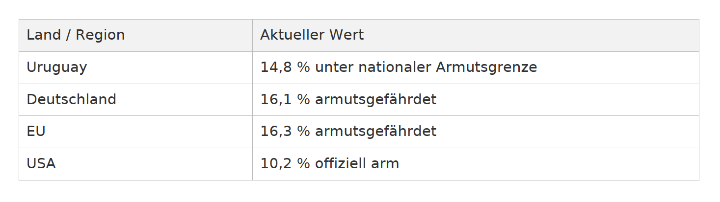
Important: This table is not a ranking. From 14.8 percent in Uruguay and 16.1 percent in Germany, one cannot conclude that poverty is lower in Uruguay. The underlying definitions are too different for that.
Why is the development interesting for emigrants?
Poverty is not a classic immigration criterion like residency rights, taxes, or cost of living. However, it is an important indicator of how income, social stability, and economic participation develop within a country.
For people who want to live, invest, or build a business in Uruguay long-term, it is particularly interesting that the poverty thresholds vary regionally. Montevideo and the interior of the country are not assessed with the same threshold - a hint at how much location, rental costs, and household size can weigh in one's own life planning.
Conclusion
The new statistics are particularly positive for Uruguay because they show a clear improvement compared to the previous year: The poverty rate fell from 17.7 to 14.8 percent, while extreme poverty also decreased.
The comparison with Germany, the EU, and the USA helps with classification but should not be read as a direct ranking. More meaningful is the development within Uruguay itself - and it shows a positive direction in the first half of 2026.
Sources and Status: Presidencia Uruguay / Instituto Nacional de Estadística, Federal Statistical Office of Germany, Eurostat, and U.S. Census Bureau. Status October 2026. The international poverty indicators are based on different methods and are therefore only partially directly comparable.