
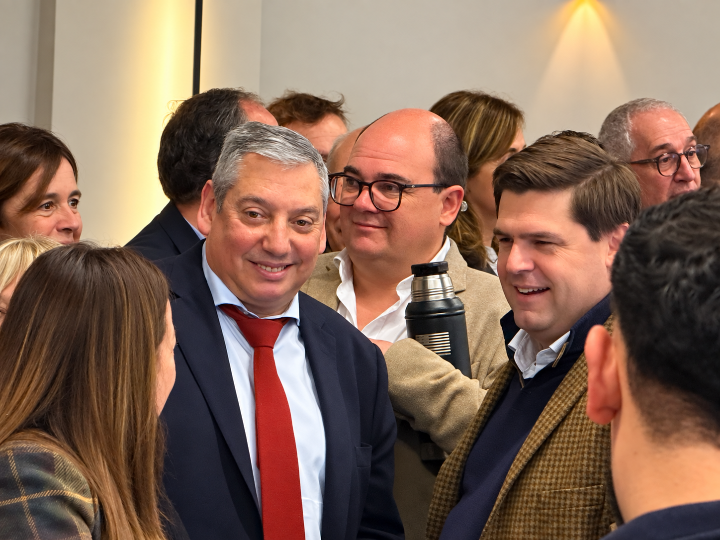
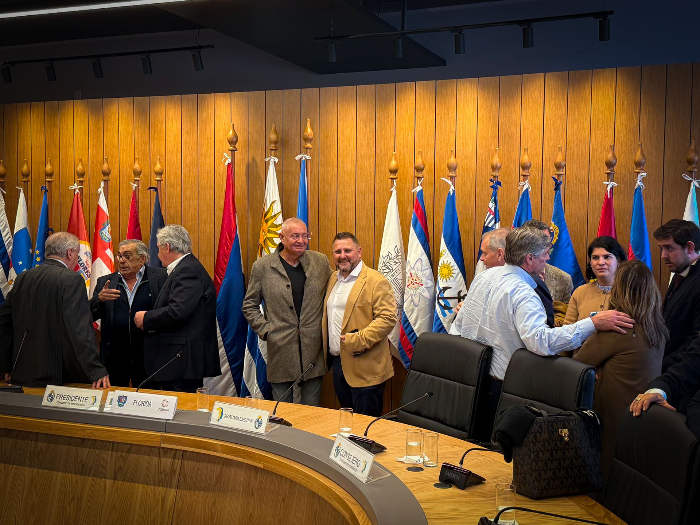
We were personally invited to attend the inauguration of Carlos Enciso as President of the Congreso de Intendentes. For us, the event also reflected something that is especially important in our work in Uruguay: direct, trusted communication with political decision-makers and key institutions — personal, straightforward, and on equal footing.
In short: The Congreso de Intendentes brings together the governments of all 19 departments of Uruguay. At Carlos Enciso’s inauguration, representatives from politics and major public institutions came together. For us, the event offered not only a valuable insight into Uruguay’s political structures, but also the opportunity to speak directly with representatives of BPS, UTE, Banco República, as well as senators and intendants.
More than a formal inauguration
At first glance, it was the official handover of a political office. In reality, the day focused on some of Uruguay’s major structural challenges.
Carlos Enciso, Intendente of the Department of Florida, assumed the presidency of the Congreso de Intendentes. This body brings together the intendants of all 19 departments, who coordinate with the national government on issues that go far beyond individual regions.
In his speech, Enciso described the Congreso as a place where “bridges” should be built — between the departments, the central government, public institutions, and society.
That idea also reflects how we understand our own work in Uruguay: relationships should not begin only when a problem arises. Long-term personal connections and open communication are what matter.
A key issue: development outside the major urban centers
A large part of Enciso’s speech focused on infrastructure in Uruguay’s interior, particularly the caminería rural, the rural road network.
These roads are essential for agriculture, forestry, and other productive sectors. At the same time, many are used daily by heavy trucks. After intense rainfall, the resulting damage can place a significant financial burden on individual Intendencias.
Enciso therefore proposed the idea of a new financing mechanism, or fideicomiso, to support rural infrastructure.
His central question was essentially: Why not start developing new solutions instead of simply managing existing structures?
President Orsi signals willingness to engage
President Yamandú Orsi also attended the event and responded to the proposals.
He described the Congreso de Intendentes as an important space for long-term political agreements and indicated that the proposed financing mechanism would be reviewed together with the Ministry of Economy and the Ministry of Transport and Public Works.
The discussion was not limited to roads. Regional development, investment, employment, and decentralization were recurring themes throughout the event.
For people who are just getting to know Uruguay, this is an important point: although the country is relatively small, its 19 departments have their own governments and play a much larger role in everyday life than many newcomers initially expect.
Direct dialogue on equal footing
Für uns war die Veranstaltung besonders, weil sich der Austausch nicht auf das offizielle Programm beschränkte.
For us, the event was especially valuable because the exchange went well beyond the official program.
In Uruguay, we work directly with contacts in politics and key institutions, on equal footing. Over time, these professional relationships have developed into trusted and friendly connections that allow issues to be discussed personally and efficiently.
During the event, we had the opportunity to speak with representatives of BPS, UTE, and Banco República, as well as senators and several intendants.
For our work in immigration, this kind of direct access is particularly valuable.
If, for example, a client has a specific question involving BPS, our role is not limited to passing along general information. We can bring the issue directly to the appropriate contact and make sure it is heard where the relevant expertise actually sits.
Put simply: if an issue needs to be discussed with BPS at the highest level, we know who to speak to.
That does not mean special treatment, and it certainly does not replace legal procedures. It does mean, however, that questions are less likely to get lost between different areas of responsibility and can be directed to the right place.
Why does this matter for our immigration work?
Immigration involves much more than forms and residency applications.
Anyone supporting people in building a new life in Uruguay needs not only to understand the rules, but also to understand how the country actually works and who the right contact is for each issue.
That includes institutions such as BPS, UTE, and Banco República, as well as Intendencias, ministries, and political decision-makers.
Our work therefore rests on two foundations: professional knowledge of procedures and requirements, and a strong personal network within Uruguay.
Especially when a case falls outside the standard process or a question requires specific clarification, direct communication can make a meaningful difference.
Relationships that grow over time
People who are new to Uruguay usually experience the country first through its procedures and institutions: Cédula, bank account, social security, housing, business registration, or various administrative steps.
Over time, it becomes clear that Uruguay is also shaped by personal relationships and direct communication.
For us, building and maintaining those relationships is therefore part of our work.
Not to shorten procedures or bypass rules, but to understand situations more quickly, identify responsibilities more clearly, and clarify complex questions in a more targeted way.
Conclusion
Carlos Enciso’s inauguration was much more than an official appointment for us.
It offered a direct insight into the way Uruguay’s departments, national government, and key institutions work together.
At the same time, the event made something visible that is essential to our daily work: we know Uruguay not only from the perspective of immigrants and applicants. We are also in direct contact with people who lead institutions, carry political responsibility, and help shape decisions.
This combination of professional expertise, a trusted personal network, and direct dialogue on equal footing is an important part of how we support people who want to make Uruguay their new home.
Note: Personal contacts and direct communication do not replace legal procedures or official responsibilities. They help us assess issues more effectively and reach the right people.